/ Research

Research focus

The Neural Plate Border (NPB) is a discrete region of the developing embryo that gives rise to the neural crest and sensory placodes. How individual NPB cells are assigned to a particular lineage remains unclear. We tackle this question using single-cell multiomics, spatial transcriptomics and perturb-seq experiments to resolve the gene regulatory networks, cell-cell organisation and signalling interactions underlying lineage segregation from the NPB.

Neural plateNPBNon-neural ectodermFGFWntBMP
01

Border specification

What are the precise ligand-receptor interactions required for lineage specification? How do BMP, Wnt and FGF gradients carve out the Neural Plate Border between neural and non-neural ectoderm? We are using CRISPR and Perturb-seq to answer these questions.
NPB progenitorBipotentSpecifiedNPBNeuralNeuralcrestPlacodeNon-neuralectoderm
02

Lineage segregation

What are the early enhancer-transcription factor relationships that set out the different NPB lineages? We are using single-cell Multiome from 10X Genomics to unravel the complex gene regulatory networks underlying individual NPB lineages.

NeuralNeuralcrestPlacodeNon-neuralectoderm
03

Cell communication

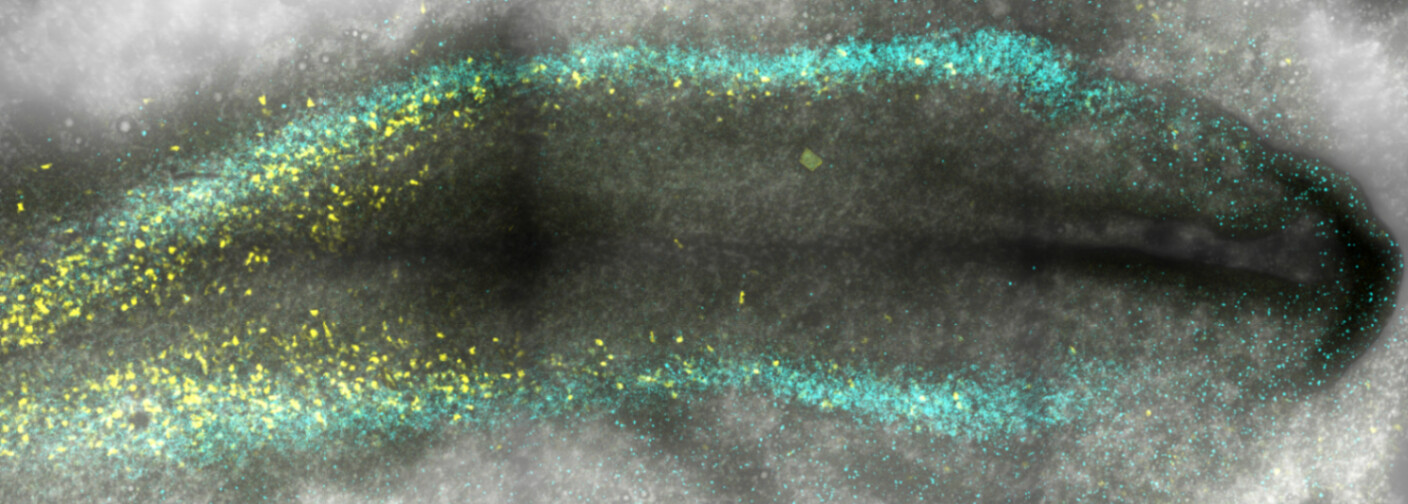
How are NPB progenitors organised? We are using spatial transcriptomics to resolve the spatial arrangements of cells within the Neural Plate Border and discover how they are communicating with each other.

Pax7 immunostaining at HH7, maximum intensity projection (stitched confocal)